How Korea’s Genius Transfer System Saves You Money on Every Ride
Key Takeaways
- Free transfers between buses and subways within 30 minutes (T-money card required)
- The system was designed to help low-income commuters who need multiple transfers from outer Seoul/Gyeonggi
- Always tap off when exiting buses — or you lose the transfer discount
- Works across Seoul, Incheon, and Gyeonggi as one integrated fare system
- A week of transfers can save you ₩16,000+ (~$12)
If you’ve traveled to other countries, you know the drill: every time you step onto a new bus or train, you pay again. Hop off the subway, catch a bus to your hotel — that’s two fares.
Korea is different. Here, when you transfer between buses and subways within 30 minutes, you pay little to nothing extra. In many cases, the transfer is completely free.
This isn’t a tourist perk or a promotional deal. It’s a deliberate system designed to make public transit fairer for everyone — and it has a powerful story behind it.
Why the Transfer System Exists: A Story About Fairness
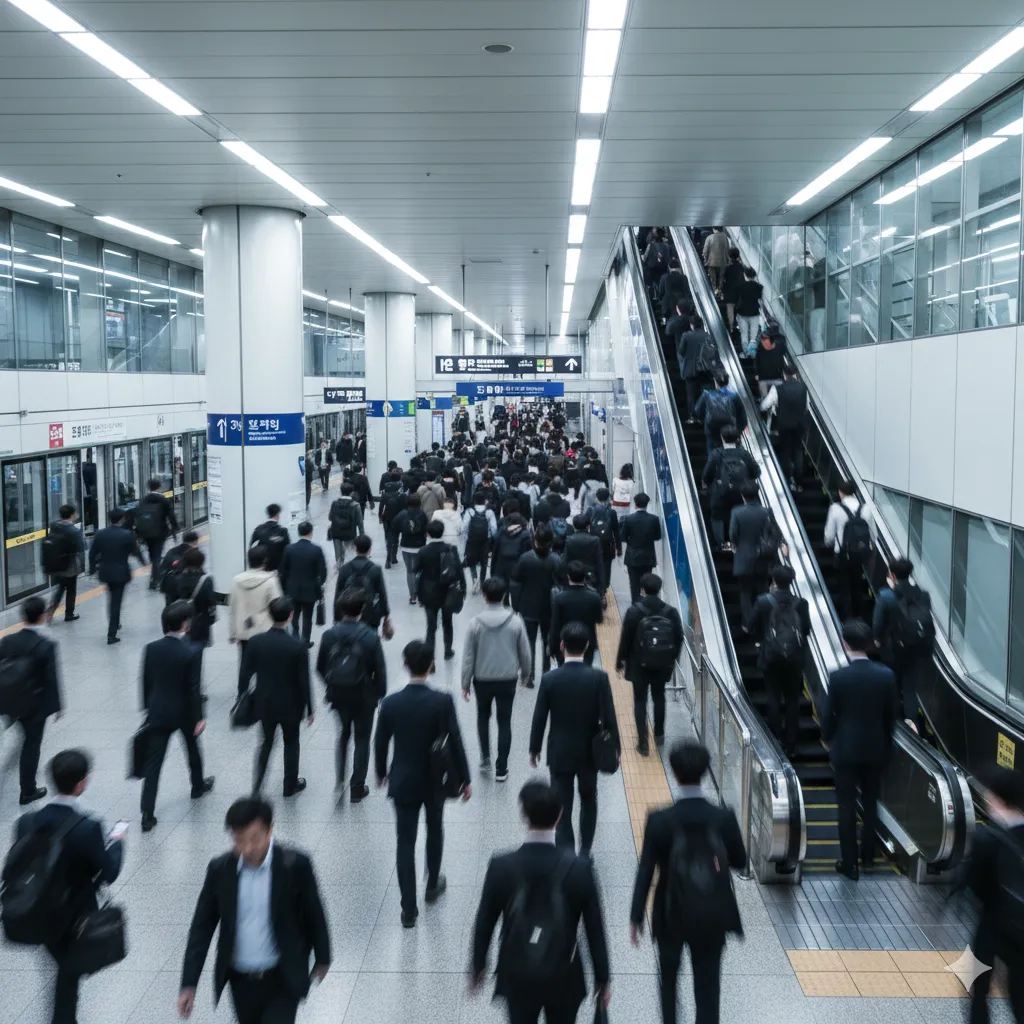
Most visitors just enjoy the cheap rides without thinking about it. But Korea’s transfer discount system was born from a very real social problem.
Here’s the reality: housing in central Seoul is expensive. Many working-class Koreans — factory workers, service staff, delivery drivers — live in outer Seoul or in satellite cities in Gyeonggi Province (the region surrounding Seoul). Their daily commute might look like this:
Walk → Local bus → Transfer to subway → Transfer to another bus → Walk to work
That’s three separate vehicles for a single commute. Without transfer discounts, these workers — the people who can least afford it — would pay three separate fares every single day, twice a day. Meanwhile, someone wealthy enough to live in Gangnam might walk to the nearest subway station and pay just once.
The result? The poorest commuters paid the most for transportation.
Korea’s government recognized this injustice and introduced the integrated fare transfer system in 2004 (Seoul) and gradually expanded it across the country. The principle is simple: you’re making one journey, so you should pay one fare — regardless of how many vehicles you need to complete it.
This is a system designed with empathy. And as a traveler, you benefit from it too.
How the Transfer System Works
The Basic Rules
| Rule | Detail |
|---|---|
| Transfer window | 30 minutes between tap-off and next tap-on (60 min after 9 PM) |
| Max transfers | Up to 4 free transfers per journey |
| Eligible combos | Bus → Subway, Subway → Bus, Bus → Bus (same number excluded) |
| Payment method | T-money or transit card only (cash riders don’t get transfer discounts) |
| Tap-off required | You must tap your card when exiting buses, or the transfer won’t register |
| Per-person rule | Transfer discounts apply per card — each person in your group needs their own T-money card |
Important: One Card Per Person
Transfer discounts are tracked per T-money card, not per trip. This means:
- Each person in your group must have their own T-money card to receive the transfer discount
- If you tap one card multiple times for a group on the same bus, the system counts each tap as a separate journey — you’ll lose the transfer connection from your previous ride
- Couples and families: buy individual cards for everyone, including children (kids’ T-money cards are available with discounted fares)
What “Free Transfer” Actually Means
The transfer discount is based on a distance-based integrated fare system. Here’s how it works in practice:
- Base fare (Seoul subway): ₩1,400 for the first 10 km
- When you transfer to a bus, the system doesn’t charge a new base fare. Instead, it continues calculating distance from where your journey began
- If your total journey distance stays within the base fare range, the transfer is free
- If you travel farther, you only pay the incremental distance surcharge — not a whole new fare
Example:
- You ride the subway 5 km → ₩1,400 (base fare)
- You transfer to a bus and ride 3 km more → ₩0 extra (still within 10 km total)
- Total cost: ₩1,400 instead of ₩1,400 + ₩1,200 = ₩2,600
You just saved ₩1,200 (about $0.90) on a single transfer. Do that twice a day for a week-long trip, and you’ve saved over ₩16,000 (~$12).
T-money: Your Key to the System
The transfer system only works with a transit card. If you pay cash, you pay full fare every time with no transfer discount.
Getting a T-money Card
| Where to Buy | Price | Notes |
|---|---|---|
| Convenience stores (CU, GS25, 7-Eleven) | ₩2,500 | Available everywhere, 24/7 |
| Subway station vending machines | ₩2,500 | Easy to find at any station |
| Incheon Airport arrival hall | ₩4,000–₩5,000 | Tourist editions (slightly pricier but collectible) |
Charging Your Card
- Convenience stores: Hand your card to the cashier and say the amount (e.g., “만원 충전” or just “charge, ten thousand won”)
- Subway machines: Insert your card, select amount, pay with cash or card
- Minimum charge: ₩1,000
- Recommended: Start with ₩10,000–₩20,000 for a week-long trip
Mobile T-money
If you have a Samsung phone with NFC, you can use Mobile T-money without a physical card. iPhone users can now use Apple Pay T-money (added in 2024) in Korea — just add it to your Wallet app.
The Golden Rule: Always Tap Off
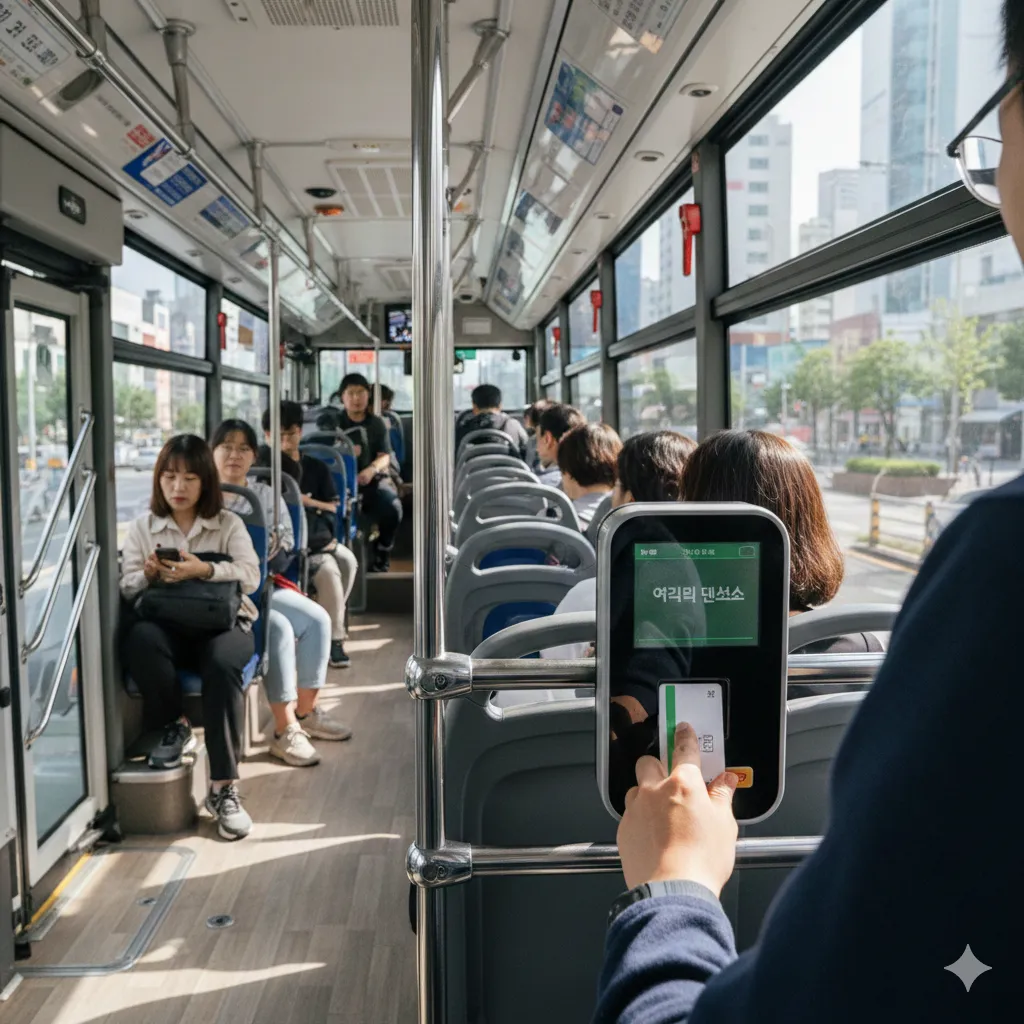
This is the single most important thing to remember:
Tap your T-money card when you GET OFF the bus.
On the subway, you must tap to exit through the gates anyway. But on buses, tapping off is optional in some countries — not in Korea. If you forget to tap off:
- You’ll be charged the maximum fare for that ride
- The transfer discount won’t activate for your next ride
- You effectively pay double
The tap-off readers are at the rear door of the bus (or sometimes both doors). You’ll hear a beep confirming the tap. Listen for it.
Transfer System Across Different Cities
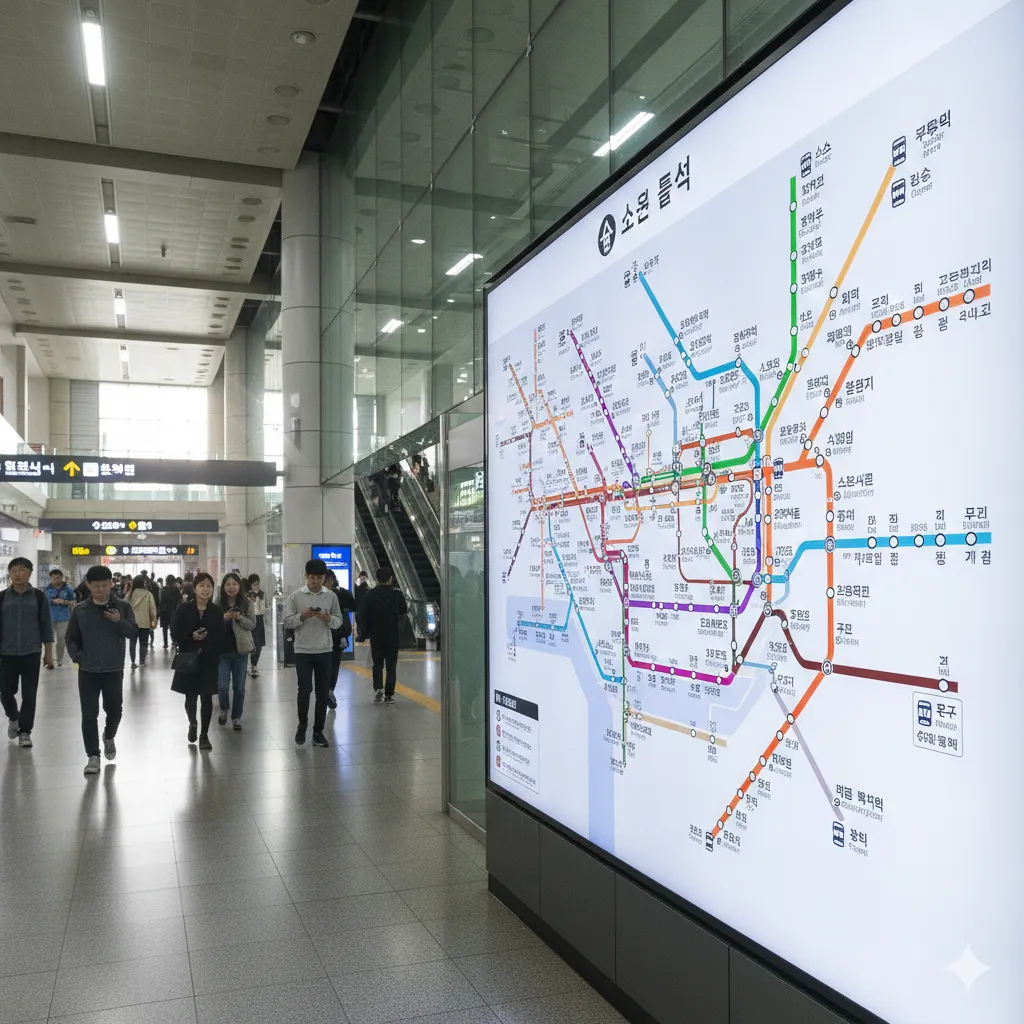
The transfer system works within most Korean cities, and increasingly between cities too:
| Route | Transfer Discount? |
|---|---|
| Seoul subway → Seoul bus | Yes |
| Seoul subway → Gyeonggi bus | Yes |
| Incheon subway → Seoul bus | Yes |
| Busan subway → Busan bus | Yes |
| Seoul bus → Gyeonggi bus | Yes |
| KTX → Local transit | No (separate system) |
| Airport express (AREX) → Seoul subway | Yes (regular service only) |
The Seoul Metropolitan Area (Seoul + Gyeonggi + Incheon) shares a fully integrated transfer system. This means you can ride a bus in Suwon, transfer to the subway, ride into central Seoul, and transfer to another bus — all on a single integrated fare.
Cost Comparison: With vs. Without Transfers
Here’s a real scenario — traveling from Incheon to Hongdae in Seoul:
| Method | Cost | Notes |
|---|---|---|
| AREX (Airport Express, regular) → Subway | ₩1,450 + ₩0 = ₩1,450 | Transfer discount applies |
| Taxi | ₩45,000–₩60,000 | Depending on traffic |
| Separate tickets (no T-money) | ₩1,450 + ₩1,400 = ₩2,850 | No transfer discount |
And a daily commuter’s scenario — outer Gyeonggi to central Seoul:
| Method | Daily Cost (Round Trip) | Monthly Cost |
|---|---|---|
| With transfer discounts | ~₩3,000 | ~₩66,000 |
| Without transfer discounts | ~₩6,000+ | ~₩132,000+ |
| Savings | ~₩3,000/day | ~₩66,000/month |
For a minimum-wage worker, that ₩66,000 monthly savings is meaningful — it’s groceries for a week.
Tips for Tourists
Buy T-money on arrival. Get one at the airport or the first convenience store you see. It’s the single most useful thing you’ll carry in Korea.
Keep ₩1,400 minimum on your card. If your balance is too low to pay the base fare, the transfer system won’t kick in. The card reader will beep angrily and you’ll have to pay cash (full fare, no discount).
Use T-money for taxis too. T-money works in most taxis — just tap when you get in and when you get out. No fumbling with cash or change.
Check your balance. Tap your T-money on any subway vending machine to see your remaining balance without charging.
Getting a refund. When leaving Korea, you can get your remaining balance refunded (minus a ₩500 fee) at any convenience store. Or just keep the card — it doesn’t expire and T-money cards make great souvenirs.
Beyond Seoul: Nationwide Integration
Korea is progressively unifying its transit systems. As of 2024, the transfer discount applies in most major cities including:
- Seoul, Incheon, Gyeonggi (fully integrated)
- Busan, Daegu, Daejeon, Gwangju (city-level integration)
- Intercity buses in some regions
The government’s long-term goal is full nationwide integration — one card, one fare system, across the entire country.
Why It Matters
Korea’s transfer system isn’t just convenient — it’s a reflection of how the country thinks about public infrastructure. The system was designed with a specific belief: essential services should be fair. A person who lives far from the city center shouldn’t be financially punished for where they live.
For travelers, it means you can explore freely — hop between neighborhoods, try street food in one district and nightlife in another — without worrying about racking up transit costs. Your T-money card is your freedom pass.
Have questions about getting around Korea? Drop a comment below and we’ll help you navigate!
Show to Staff
Useful Korean Phrases
Tap any phrase to show it full-screen on your phone
티머니 카드 주세요
ti-meo-ni ka-deu ju-se-yo
T-money card, please
원 충전해주세요
chung-jeon-hae-ju-se-yo
Please charge 10,000 won
지하철역이 어디에 있나요?
ji-ha-cheol-yeog-i eo-di-e in-na-yo?
Where is the subway station?
명이요
myeong-i-yo
There are 2 of us (please tag 2 cards)
잔액 확인 부탁드려요
jan-aek hwag-in bu-tak-deu-ryeo-yo
Please check my balance
Join the Conversation
Comments
Loading comments...
Sign in with Google to leave a comment